
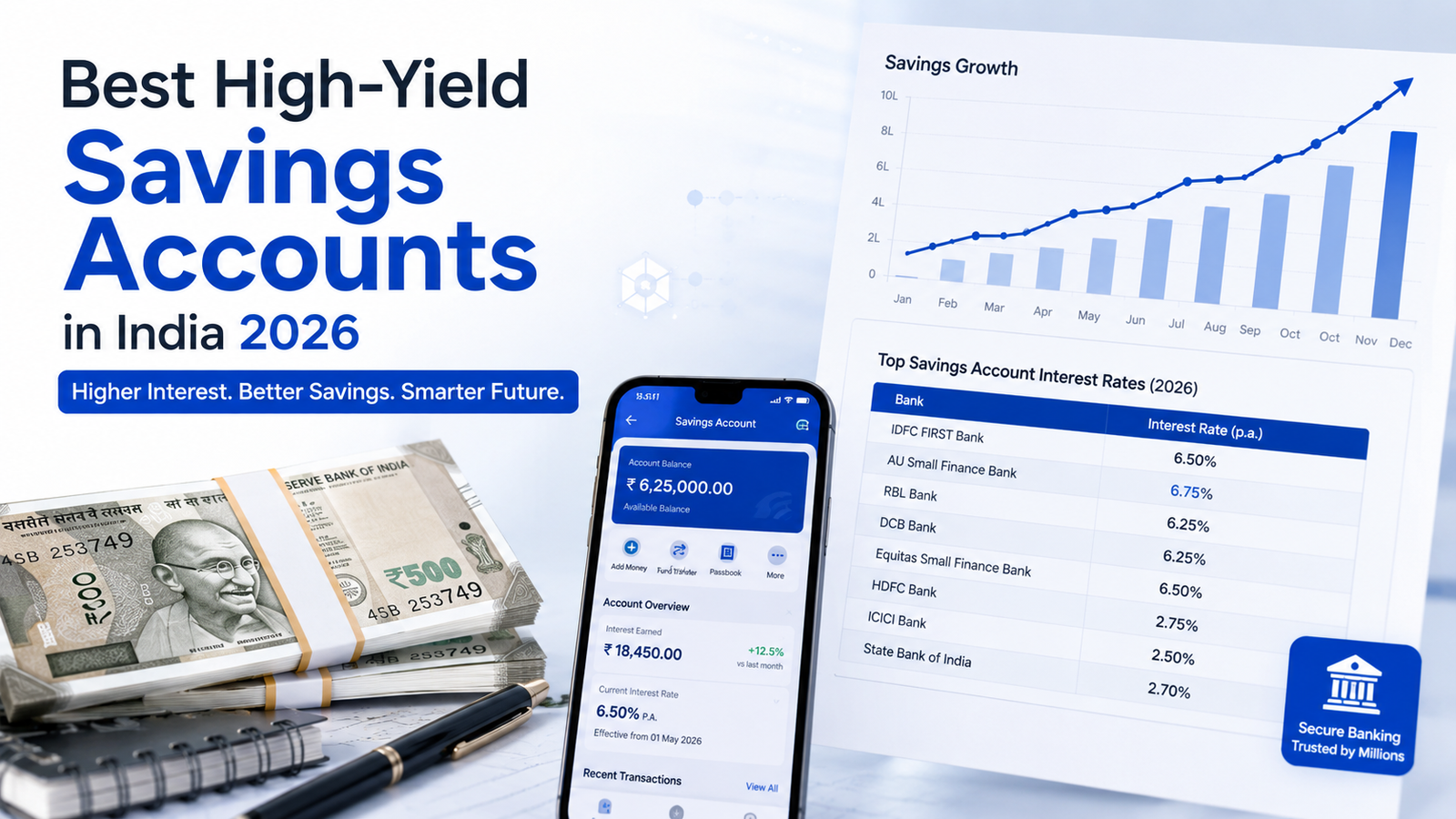
In 2026, several banks in India offer better savings account interest rates than the usual 2.5% to 3% offered by many large banks. Some private banks and small finance banks offer higher rates on selected balance slabs. These accounts are useful for people who want liquidity, easy access, and better returns without locking money in a fixed deposit.
But there is one important point: the account with the highest advertised interest rate is not always the best account for everyone. You must check balance slabs, minimum balance rules, bank charges, service quality, digital banking experience, and deposit insurance before opening an account.
Quick Answer: Some of the best high-yield savings accounts in India in 2026 include IDFC FIRST Bank, AU Small Finance Bank, RBL Bank, DCB Bank, Equitas Small Finance Bank, Jana Small Finance Bank, Suryoday Small Finance Bank, and Utkarsh Small Finance Bank. For daily banking and brand comfort, HDFC Bank, ICICI Bank, SBI, Axis Bank, and Kotak Mahindra Bank may still be practical, but their savings account interest rates are usually lower.
What Is a High-Yield Savings Account?
A high-yield savings account is a regular savings account that gives a higher interest rate than a standard bank savings account. You can use it for deposits, withdrawals, UPI payments, ATM usage, online banking, and fund transfers, just like a normal savings account.
The main difference is the interest rate. A regular savings account may offer around 2.5% to 3% per year, while a high-yield savings account may offer 5%, 6%, or even higher on selected balance slabs.
For example, if you keep ₹5 lakh in a savings account earning 2.5%, your yearly interest before tax is around ₹12,500. If the same amount earns 5%, your yearly interest becomes around ₹25,000. That is a difference of ₹12,500 in one year without taking market risk.
Best High-Yield Savings Accounts in India 2026: Comparison Table
| Bank | Indicative Interest Rate | Best For | Key Point |
|---|---|---|---|
| IDFC FIRST Bank | Up to 6.50% p.a. on selected slabs | Emergency fund, salary surplus, short-term savings | Good mix of higher interest and digital banking |
| AU Small Finance Bank | Up to 6.50% to 6.75% p.a. on selected slabs | People keeping higher savings balances | Attractive rates, but check slab rules carefully |
| RBL Bank | Competitive slab-based rates | Private bank users wanting better-than-average returns | Useful for selected balance ranges |
| DCB Bank | High rates on selected higher slabs | Rate-focused savers | Rates vary sharply by balance slab |
| Equitas Small Finance Bank | Up to 6.50% to 7% p.a. on selected slabs | Separate savings and emergency fund account | Good for people comfortable with small finance banks |
| HDFC Bank | Lower than high-yield banks | Salary account and daily banking | Strong convenience, lower interest |
| ICICI Bank | Around 2.50% p.a. | Digital banking and daily use | Not a high-yield option |
| SBI | Usually lower than high-yield banks | Trust, reach, pension, government-linked banking | Best for comfort, not highest returns |
Important: Savings account interest rates can change anytime. Always check the bank’s official website before opening an account.
Top High-Yield Savings Accounts in India
1. IDFC FIRST Bank Savings Account
IDFC FIRST Bank is one of the strongest names in the high-yield savings account space. It offers attractive rates on selected balance slabs and is also known for a good digital banking experience.
This account can be useful for people who keep a regular surplus in their bank account and want better interest without locking money in a fixed deposit.
Why it stands out:
- Competitive interest on selected slabs
- Good digital banking experience
- Useful for emergency funds and short-term savings
- Suitable for salaried users, freelancers, and families
Best for: People who want a balance between higher savings interest and smooth digital banking.
2. AU Small Finance Bank Savings Account
AU Small Finance Bank is another popular option for people looking for higher interest on savings account balances. It offers better rates on selected balance slabs, especially when the account balance is higher.
Since it is a small finance bank, you should also check your comfort level, branch availability, service quality, and account charges before opening the account.
Why it stands out:
- Attractive interest rates on higher balance slabs
- Good option for parking surplus funds
- Useful for people who want better returns than large private banks
- Digital account opening options may be available
Best for: People who keep ₹5 lakh or more in savings and want better interest with liquidity.
3. RBL Bank Savings Account
RBL Bank offers slab-based savings account interest rates. It can be a suitable option for people who want a private bank account with better savings returns than many large banks.
The benefit depends on how much money you keep in the account. If your balance falls in a lower slab, the effective return may not be very high. That is why checking the latest slab structure is important.
Why it stands out:
- Better-than-standard savings account rates on selected balances
- Private bank option for urban users
- Useful for short-term cash parking
Best for: People who want a private bank account with relatively better savings interest.
4. DCB Bank Savings Account
DCB Bank is often compared by people searching for high-interest savings accounts in India. Its rates are slab-based, and the higher rates usually apply only after a certain balance level.
This account may suit people who actively compare rates and are comfortable banking with a smaller private sector bank.
Why it stands out:
- Competitive rates on selected higher slabs
- Useful for surplus cash
- Good option for rate-conscious savers
Best for: People who maintain higher balances and want to earn more than a standard savings account.
5. Equitas Small Finance Bank Savings Account
Equitas Small Finance Bank offers attractive savings account interest rates on selected balance slabs. It can be considered by people who want a separate account for emergency funds, short-term savings, or idle cash.
As with any small finance bank, do not look only at the interest rate. Check account charges, branch availability, app quality, and your comfort level before opening the account.
Why it stands out:
- Good interest rates on selected balance ranges
- Useful for separate savings goals
- Can work well for people who do not need frequent branch visits
Best for: Savers who want higher returns and are comfortable with small finance banks.
Best Savings Account Based on Your Need
| Your Need | Banks to Compare | Why |
|---|---|---|
| Highest savings interest | IDFC FIRST, AU Bank, DCB, Equitas, RBL | These banks offer higher rates on selected slabs |
| Salary account | HDFC Bank, ICICI Bank, Axis Bank, SBI | Better employer tie-ups, support, and branch reach |
| Emergency fund | IDFC FIRST, AU Bank, SBI, RBL | Good balance of liquidity and accessibility |
| Senior citizens | Savings account + FD + SCSS mix | Savings account gives liquidity, but FD and SCSS may offer better returns |
| Students | SBI, HDFC Bank, ICICI Bank, Kotak, Axis Bank | Low balance requirement and daily banking convenience matter more |
| Freelancers | IDFC FIRST, AU Bank, RBL, DCB | Useful for irregular income and short-term cash parking |
How Savings Account Interest Is Calculated in India
In India, savings account interest is generally calculated on the daily closing balance. The interest is then credited monthly or quarterly, depending on the bank.
Here is a simple example:
- If you keep ₹1,00,000 at 3% p.a., your yearly interest is about ₹3,000 before tax.
- If you keep ₹5,00,000 at 5% p.a., your yearly interest is about ₹25,000 before tax.
- If you keep ₹10,00,000 at 6% p.a., your yearly interest is about ₹60,000 before tax.
This is why high-yield savings accounts become more useful when you keep a larger balance. If your average balance is only ₹10,000 or ₹20,000, the difference will not be very big.
High-Yield Savings Account vs Fixed Deposit
| Feature | High-Yield Savings Account | Fixed Deposit |
|---|---|---|
| Liquidity | Very high | Lower, unless you break the FD |
| Interest rate | Variable | Fixed for selected tenure |
| Best use | Emergency fund and short-term savings | Money not needed for a fixed period |
| Premature penalty | Usually no | May apply |
| Rate certainty | Bank can revise rates | Rate is locked after booking |
A high-yield savings account is better when you need quick access to money. A fixed deposit is better when you can keep money aside for a fixed period and want certainty of return.
High-Yield Savings Account vs Liquid Fund
Many personal finance experts recommend liquid funds for emergency money, but they are not the same as savings accounts. A savings account is simpler, easier to use, and directly linked to UPI, debit card, ATM, and net banking.
A liquid fund may offer better returns in some periods, but it carries market-linked risk, even if the risk is low. Redemption also may not feel as instant as withdrawing from a bank account.
| Feature | High-Yield Savings Account | Liquid Fund |
|---|---|---|
| Risk | Bank deposit risk | Low market-linked risk |
| Access | Instant | Usually quick, but not the same as bank cash |
| Best for | Emergency cash and daily liquidity | Short-term surplus with slightly higher return potential |
| Ease of use | Very easy | Requires mutual fund account or investment platform |
For most people, a mix works best. Keep immediate emergency money in a savings account and extra short-term surplus in FD or liquid funds based on your comfort.
Things to Check Before Opening a High-Yield Savings Account
1. Balance Slabs
Most high-yield savings accounts follow a slab-based structure. The highest rate may apply only above a certain balance. For example, a bank may advertise “up to 6.50%,” but the rate may apply only after ₹5 lakh, ₹10 lakh, or another specific balance level.
2. Minimum Balance Requirement
Some accounts require a minimum average monthly balance. If you do not maintain it, the bank may charge a penalty. This can reduce the benefit of higher interest.
3. Account Charges
Check debit card charges, SMS charges, cash deposit charges, ATM withdrawal limits, cheque book charges, and account closure charges. A high interest rate is not useful if charges eat into your returns.
4. Deposit Insurance
Bank deposits in India are insured up to ₹5 lakh per depositor per bank, including principal and interest. This insurance is provided by DICGC. If you keep more than ₹5 lakh in one bank, understand that the insurance limit does not cover the full amount.
5. Digital Banking Experience
If you use UPI, mobile banking, net banking, bill payments, and transfers regularly, the app experience matters. A slightly lower rate with better service may be better than a higher rate with poor digital banking.
6. Branch and Customer Support
If you prefer branch banking, check whether the bank has a branch near your home or office. Small finance banks may not have the same branch reach as SBI, HDFC Bank, or ICICI Bank.
7. Your Actual Balance
Do not choose an account only by looking at the highest possible rate. Choose based on your usual balance. If you normally keep ₹50,000, an account giving high rates above ₹10 lakh may not help you much.
How Much Interest Can You Earn?
Here is a simple comparison to understand the difference between a normal savings account and a high-yield savings account.
| Average Balance | At 2.50% p.a. | At 5.00% p.a. | At 6.50% p.a. |
|---|---|---|---|
| ₹1,00,000 | ₹2,500 | ₹5,000 | ₹6,500 |
| ₹5,00,000 | ₹12,500 | ₹25,000 | ₹32,500 |
| ₹10,00,000 | ₹25,000 | ₹50,000 | ₹65,000 |
These are simple annual estimates before tax. Actual interest may differ because banks use slab-based rates and calculate interest on daily closing balance.
Tax on Savings Account Interest in India
Savings account interest is taxable in India. It is added to your total income and taxed as per your income tax slab.
However, individuals can claim a deduction of up to ₹10,000 under Section 80TTA on savings account interest. Senior citizens can claim deduction under Section 80TTB, subject to applicable tax rules.
This means you should not compare savings account interest only on a pre-tax basis. If you are in a higher tax slab, your post-tax return will be lower.
Should You Keep More Than ₹5 Lakh in One Savings Account?
You can keep more than ₹5 lakh in one savings account, but you should understand the risk. The DICGC insurance limit is ₹5 lakh per depositor per bank, including principal and interest.
If safety is your top priority, avoid keeping all your savings in one bank. You can split money across different banks, fixed deposits, and other low-risk options.
A practical structure can be:
- Keep 1 month of expenses in your main salary account.
- Keep 3 to 6 months of expenses in a high-yield savings account or sweep FD.
- Keep extra money in fixed deposits, liquid funds, or other suitable options.
Who Should Open a High-Yield Savings Account?
A high-yield savings account can be useful if:
- You keep more than ₹1 lakh idle in your bank account.
- You are building an emergency fund.
- You want better returns without locking money.
- You are a freelancer or business owner with irregular income.
- You want a separate account for short-term goals.
- You are comfortable checking bank rates and charges.
Who May Not Need a High-Yield Savings Account?
You may not need one if:
- You keep only a small balance in your savings account.
- You prefer only large banks for peace of mind.
- You do not want to track slabs and charges.
- You already use sweep-in fixed deposits efficiently.
- You need frequent branch support and the bank has limited presence in your city.
Common Mistakes to Avoid
Choosing Only by Highest Rate
The highest rate may apply only to a small portion of your balance or only above a very high balance. Always check the full slab structure.
Ignoring Charges
Debit card fees, non-maintenance charges, and transaction charges can reduce your benefit.
Keeping All Money in One Bank
For safety, it is better to spread large savings across banks and instruments.
Not Checking Rate Changes
Savings account rates are not fixed. Banks can revise them. Check rates every few months.
Using Emergency Fund for Daily Spending
If your emergency fund is in the same account as your daily spending money, it becomes easier to use it casually. A separate account helps maintain discipline.
Best Strategy for Personal Finance in 2026
For most people, the best approach is not to depend on one account. A two-account system works better.
- Main account: Use this for salary, EMI, UPI, bill payments, and daily expenses.
- High-yield savings account: Use this for emergency fund and short-term savings.
If your savings grow beyond ₹5 lakh to ₹10 lakh, consider splitting money across different banks or using fixed deposits and liquid funds based on your financial goals.
Final Verdict
The best high-yield savings account in India in 2026 depends on your balance, comfort with the bank, and need for liquidity. IDFC FIRST Bank, AU Small Finance Bank, RBL Bank, DCB Bank, and Equitas Small Finance Bank are worth comparing if your main goal is higher savings interest.
For daily banking, salary accounts, branch reach, and comfort, large banks like HDFC Bank, ICICI Bank, SBI, Axis Bank, and Kotak Mahindra Bank may still be better, even though their interest rates are usually lower.
If you keep a large amount in your savings account, do not let it sit idle at a low rate. Compare high-yield savings accounts, check the latest slabs, understand the charges, and choose an account that gives you the right mix of return, safety, and convenience.
FAQs
Which bank gives the highest savings account interest in India in 2026?
Banks such as IDFC FIRST Bank, AU Small Finance Bank, DCB Bank, RBL Bank, Equitas Small Finance Bank, Jana Small Finance Bank, Suryoday Small Finance Bank, and Utkarsh Small Finance Bank offer competitive savings account interest rates on selected slabs. The highest rate depends on your balance and the latest bank rate card.
Are high-yield savings accounts safe?
High-yield savings accounts are bank accounts regulated in India, but safety depends on the bank. Deposits are insured up to ₹5 lakh per depositor per bank by DICGC, including principal and interest.
Is savings account interest taxable?
Yes, savings account interest is taxable as per your income tax slab. Eligible individuals can claim deduction up to ₹10,000 under Section 80TTA. Senior citizens may get deduction under Section 80TTB, subject to tax rules.
Is a high-yield savings account better than FD?
A high-yield savings account is better for liquidity. A fixed deposit is better when you want a fixed return for a fixed period. Savings account rates can change, while FD rates are locked after booking.
Can I use a high-yield savings account for emergency funds?
Yes, a high-yield savings account is one of the easiest places to keep emergency money because it gives liquidity and better interest than many normal savings accounts.
Should I keep all my money in the bank with the highest rate?
No. Do not choose only by interest rate. Check deposit insurance, bank reputation, account charges, service quality, app experience, and your own comfort level.
Do NRIs get the same savings account interest rates?
NRIs usually need NRE or NRO accounts. Rates and tax treatment may be different from resident savings accounts, so NRIs should check the bank’s NRE/NRO savings account rate page separately.
How often do savings account interest rates change?
Banks can revise savings account interest rates anytime. It is better to check the latest rates on the bank’s official website before opening an account.